More Than a Layout: Espen Veiby’s Architecture of Movement
Abandoning traditional corridors for a clever system of interior paths, architect-chef Espen Veiby has transformed his Oslo home. The result is a masterclass in spatial choreography, where light and movement dictate the soul of the apartment.

Photo: Espen Grønli, Text: Marianne Lie Berg
On the top floor of a beautiful brick building from 1937 in Adamstuen, white surfaces are broken up by design elements in strong contrasting colours. Light floods in through a number of ingenious solutions. Everything has been planned down to the smallest detail with impressive craftsmanship.
- When I took over the apartment, it had the original 1937 floor plan partially reorganised. Large but tight spaces made the apartment feel dark and cramped despite its spacious 95 square metres and the fact that it was continuous. ‘I'm very keen to bring in as much natural daylight as possible in all the projects I work on, and I saw that I could create two continuous axes that would let the light through and create a completely different flow in the apartment,’ Espen Veiby explains.

adjusted. In the living room, the fireplace insert has been lowered to accommodate a lower seating position than in the dining room zone. Espen has created a home office by assembling a specially ordered steel plate with three legs from Finnish Design Shop. A lamp from Flos subtly illuminates the brick wall.
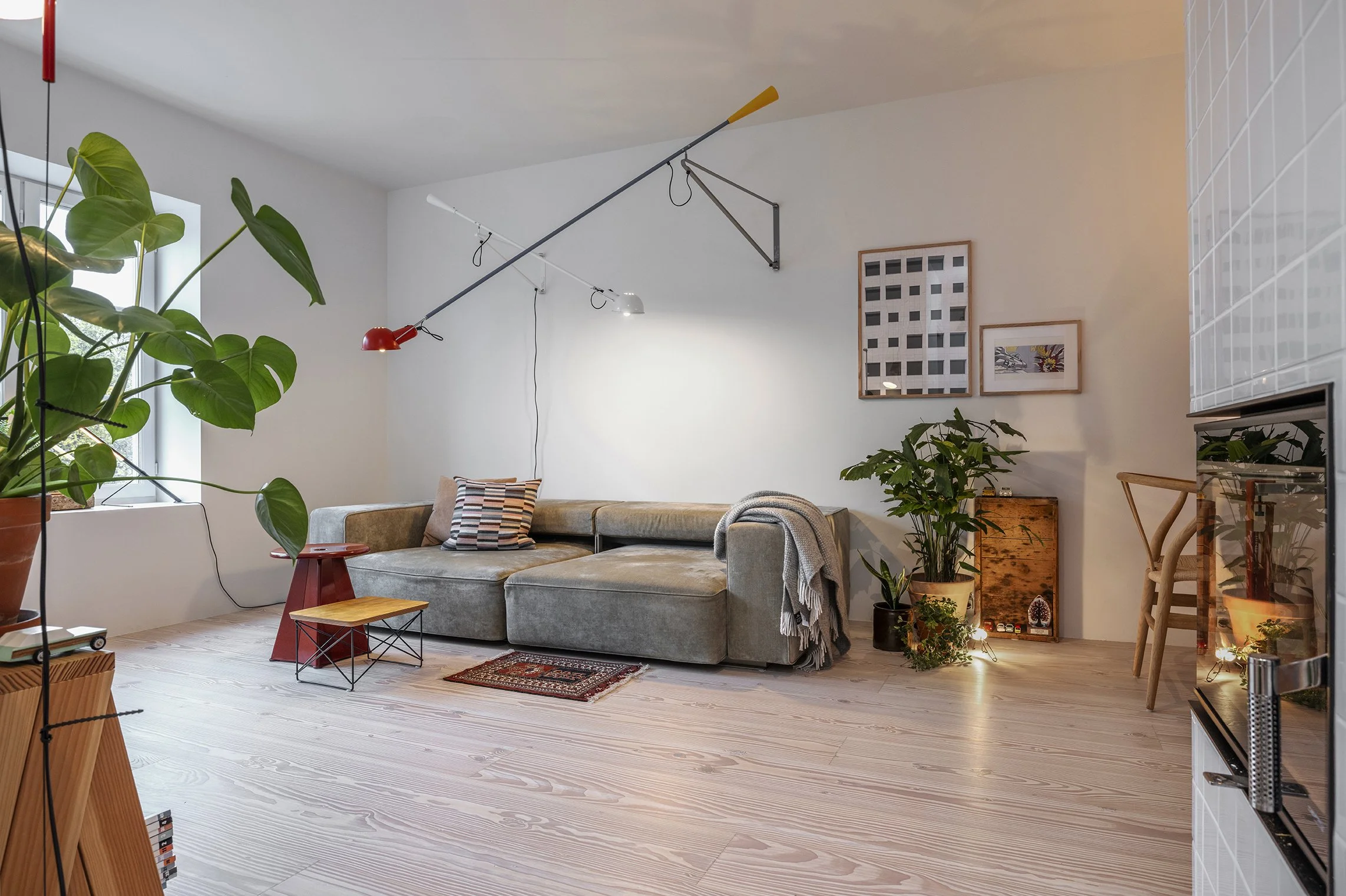
new & old. The sofa is from B&B Italia, bought at Expo Nova, while another LTR coffee table from Vitra stands together with a Tabouret Metallique, designed by Jean Prouvet from Vitra. The wooden box is my grandfather's old tool drawer, and the lamps above the sofa are the same as in the dining room. Note the Global knife-like handle on the fireplace insert.
restructuring
This involved taking down walls and ripping out old floor coverings to open up the space. You can see the original brick that Espen has deliberately allowed to penetrate the walls in parts of the apartment as a decoration next to the otherwise chalk-white walls. The tile comes out into the hallway, goes through one of the boxes and into the living room. Douglas fir was laid on the floor, and the elongated plank boards extend through the apartment. In the centre of the apartment, Espen designed two boxes containing a bathroom, wardrobe, two fireplace inserts and parts of the kitchen. There was also space for both a hot water heater and a recessed wood box in the boxes.
- The boxes are the central system you move around. You walk along the two main axes, where there are five walkways that criss-cross and take you to the different zones in the apartment. The cubicles are clad in the same Douglas planks as the floors, with the exception of the tiled ends facing the living room and kitchen,’ explains the architect.

memories. From the walkway leading from the living room to the bedroom area, you can see the window set into the wall of the main bathroom. The old pig's trough from the home town of Veiby serves as an extra wood box and flower pot. The small stool from Kollekted BY serves as a magazine rack with space for a small model aeroplane and a micro flowerpot. Espen is both a car and aeroplane enthusiast, in addition to being a lamp enthusiast.
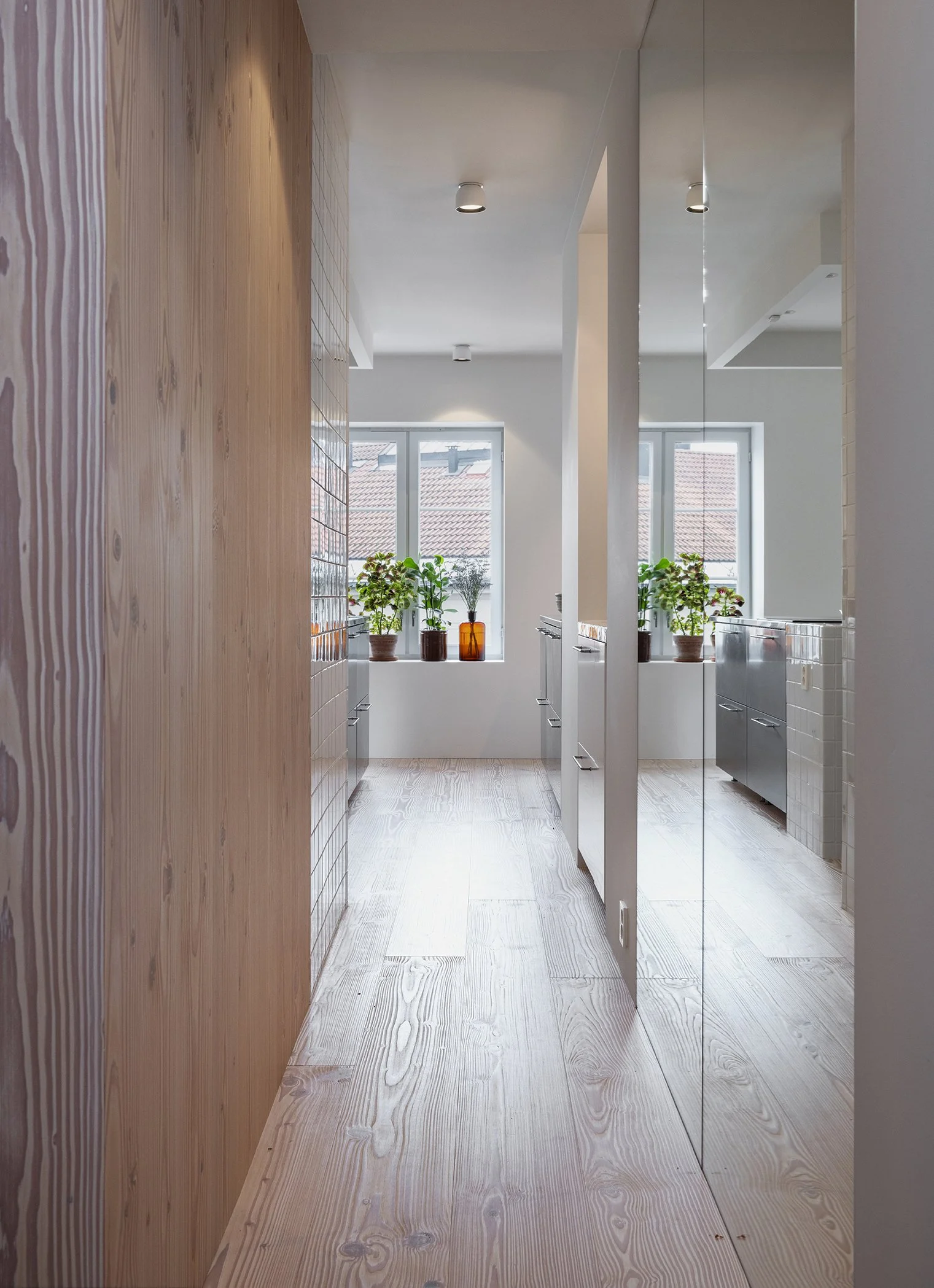
sightlines. As you enter the apartment, you can see all the way to the kitchen. The mirrored surfaces extend from floor to ceiling and reflect the kitchen fittings. The ceiling spotlights designed by Flos are deliberately pulled up in this part of the apartment, while those on the facades are pulled down.

expert. Espen is a trained chef and loves to cook with friends. Gastronorm wells are recessed into the steel plate on the kitchen island where Espen keeps herbs and oil bottles. The steel plate extends beyond the cabinets on one side to form a seat for two stools. On the wall above the sink hangs a lamp from the former pigsty at the family home. An aluminium pendulum designed by Daniel Rybakken hangs over the washing-up area like a thin line. On the window sill in the guest room behind the kitchen is the Mayday lamp designed by Konstantin Grcic in 2000 for Flos.

split solution. Note the division of the kitchen into two areas. The steel section comprises the sink and worktop, while the tiled section forms the warm zone in the kitchen. The recess in the ceiling above the kitchen island will be fitted with a steel grille that will act as a diffuser for the ceiling spotlights. The guest room is located behind the kitchen with access to the apartment's laundry room, where a window has been installed near the ceiling.
urban versus homely
Espen knows what he's talking about when it comes to creating flow to manage movement in both private and public spaces. As an architect and partner at A-lab, he works on designing urban floors in new urban areas. Among other things, he has been involved in designing the urban floor in Barcode and Bispevika and knew exactly how the city's population would use their new neighbourhood many years before it was actually completed.
- In the bigger picture, when designing a new urban area, such as Bispevika, we need to think about where the footpaths go before we design the buildings, to make sure we create safe and good zones where people can thrive. What kind of facade faces the various road junctions, what are the sight lines, where can people sit down, where can children play, etc. You could say that the same applies only on a much smaller scale in a home. It's important to create a flow and facilitate interaction between the various functions and activities you do in a home to streamline and simplify everyday tasks.

Inherited. Espens grandmother's cacti, which are over 50 years old, are on display on the windowsill that lets light into the laundry room.

Neat decor. Small tableaux are arranged around the apartment, such as here on the windowsill where a Lampedina from Flos, designed by Achilles Castliglionis in 1972, stands alongside small vases from the Veiby smallholding and a youthful portrait of Espen's mother.
zones
In his own home, Espen has opted for zones instead of rooms. When you enter the apartment, you'll find yourself in the corridor that runs along one of the main axes. From here, you can orientate yourself in relation to the two main axes. The master bedroom is at one end of the corridor, the kitchen at the other. Straight ahead, a walkway leads to the other main axis where the social zones are lined up; from the main living room with its own office nook, to a small lounge and on to the dining area that meets the kitchen.
- ‘When I'm designing a solution, I go through what I have to do. What can I do to make these tasks as streamlined as possible? How does it make the most sense to move around. This ranges from where I can leave my shopping bags when I'm clearing out the groceries to the sight lines from the sofa.

Axis. Along this main axis, the social zones are arranged in a row. The same Douglas fir is used on the walls of the boxes as on the floor. A Vitra LTR coffee table, designed by Charles and Ray Eames in 1950, is accompanied by a Mariposa Butterfly chair and a Cubas chair in the lounge zone.
making it flexible
The corridor consists of a small seating area recessed into one of the boxes. Here, glass panels have been added to the rear walls to enlarge the impression of the corridor. A large mirrored surface has also been added to the corridor wall leading to the kitchen to reveal that the kitchen extends around the corner of one of the boxes.
- Today, the apartment only has two bedrooms. The guest bedroom is located behind the kitchen with its own entrance via the back stairs. The idea is that the largest living room can be converted into a third bedroom without losing the living room area. ‘By inserting the light wall slightly into what is currently a spacious living room, the work nook can be converted into a living area facing the fireplace insert,’ explains Espen.
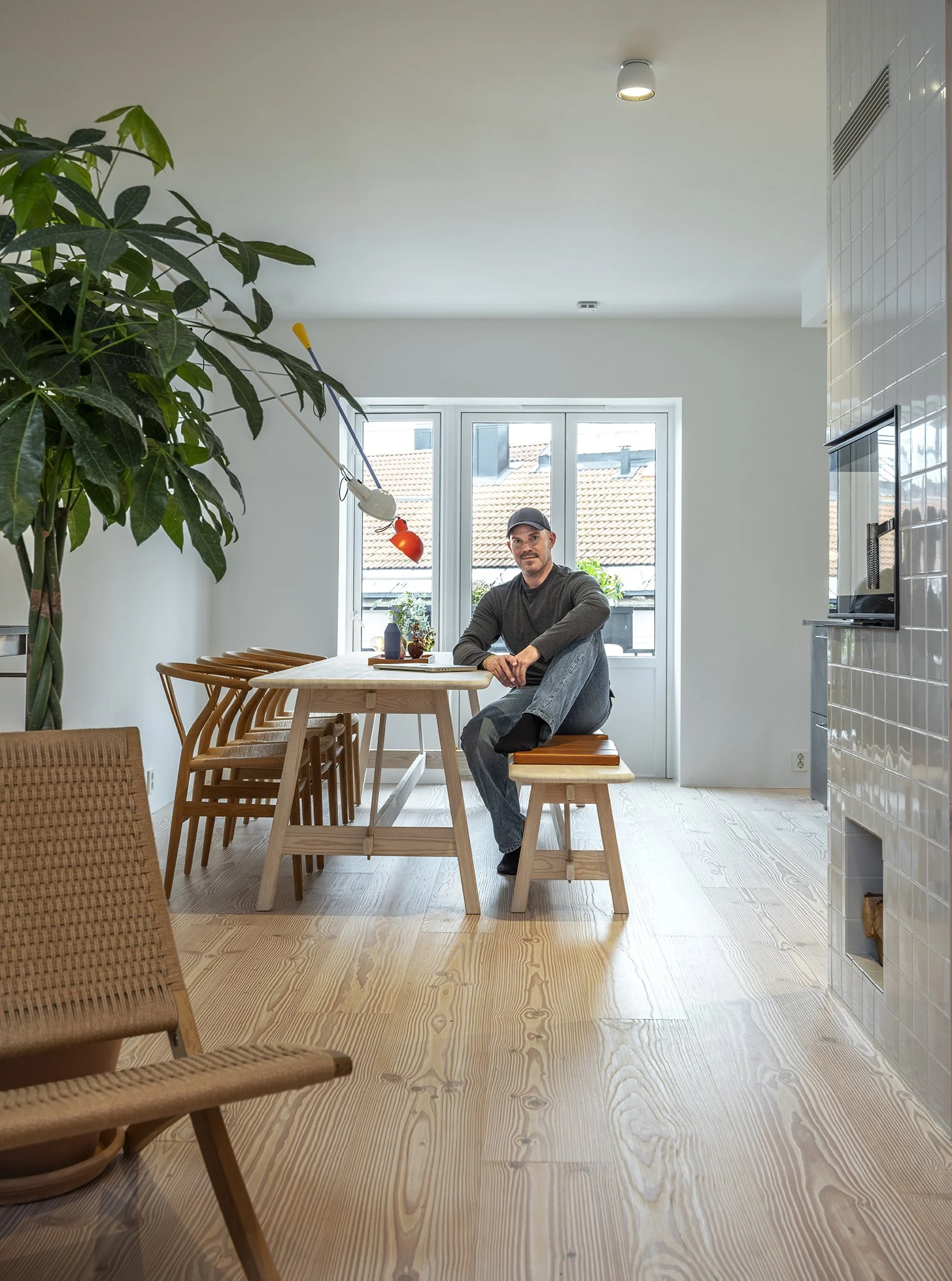
Multi Artist. Espen Veiby is a trained chef and architect/interior architect. His fascination with designer furniture shines through in the interior. The dining table and stool were designed by Tre Sekel and purchased from Kollekted BY, while the chairs are Hans J. Wegner's Y-chairs.
translucent
There are no closed doors in the apartment, nor in the bedrooms, all of which have recessed glass panels to ensure that light flows in and around every nook and cranny. There's even a doorway at the far end of the outer wall between the master bedroom and the living room that allows the light to move between the two large windows.
- I've had a track installed in the ceiling of both bedrooms that allows you to draw a curtain to create privacy. A solution that is common in hotels. I've also also installed window niches up by the ceiling in the bathrooms and laundry room, rooms that
otherwise wouldn't get any natural daylight. These windows have also been fitted with window sills so that plants and decorative items can be seen in the rooms on the other side,’ he says.

With soul. Espen inherited the wooden shelf above the steel trolley from Ikea from his grandmother. Here is a vase designed by Falke Svatun. Queen Elisabeth is accompanied by a blue candlestick from Hay. On the bottom shelf is a salt and pepper shaker set designed by Norway Says for Muuto. Achilles Castiglioni's Parentesi lamp from Flos is a decoration in itself.

An interplay. The colours of the 265 lamp designed by Paolo Rizzatto from Flos are echoed in a Turning Tray designed by Finn Juhl in 1965 and a Chim Chim diffuser designed by Ryosuke Fukusada and Rui Pereira for Hay.
the commercial kitchen
Having worked as a chef at restaurants ranging from Grand to Continental and Bølgen & Moi, Espen was clear that he wanted a commercial kitchen adapted to home scale.
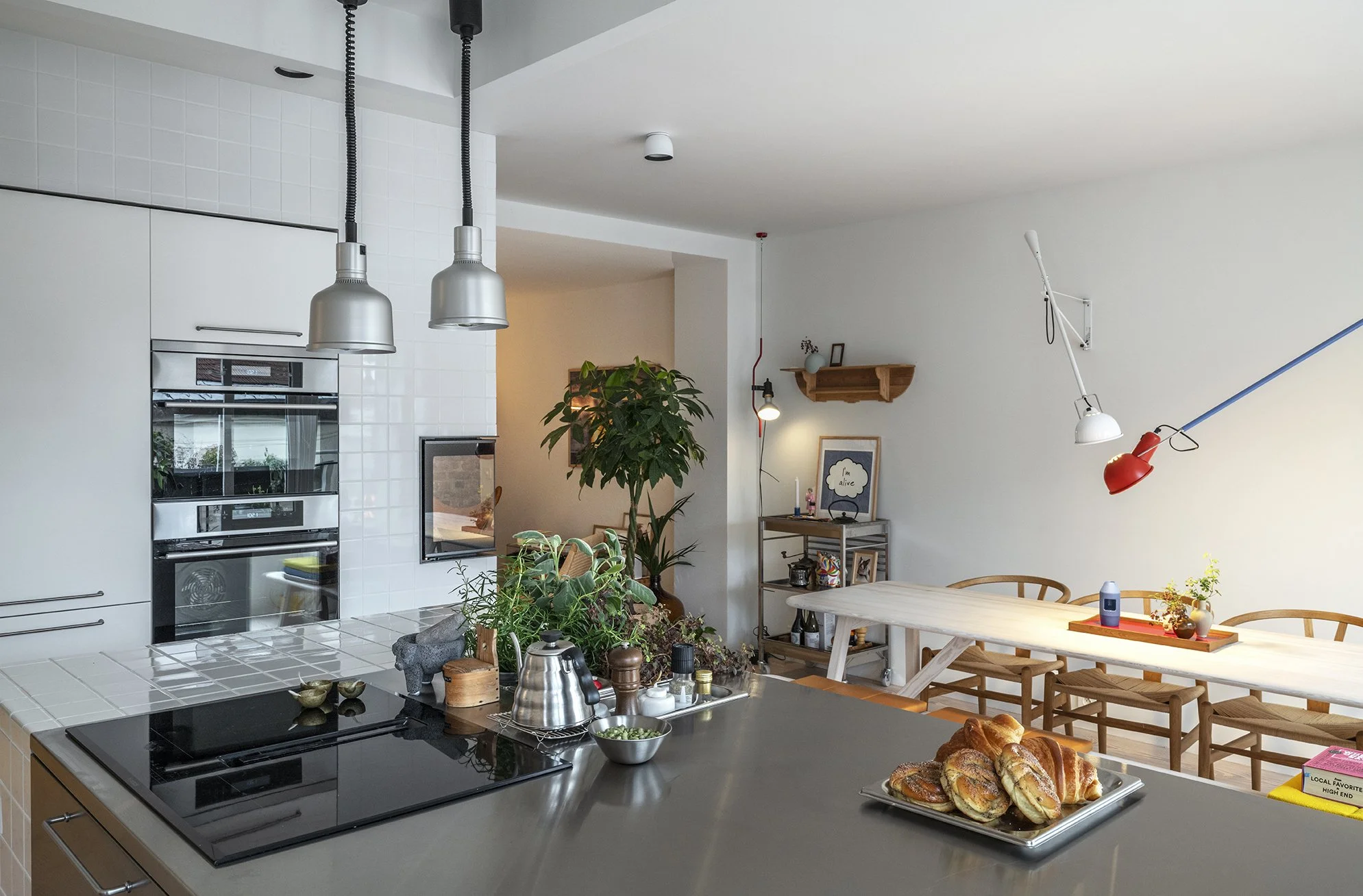
- ‘The kitchen is structured according to the workflow of a commercial kitchen with a dishwashing zone on the back wall, a kitchen island with commercial kitchen elements such as gastronomer for hot baths or herbs, a heating zone to keep the food warm and a fridge and stove recessed into the wall in one box for the right working height,’ explains the chef.
The white tiles on the box continue into the kitchen zone and form the end piece of the kitchen island. This is where the chef puts the hot pans he takes out of the oven. This is also where he arranges plates, which he keeps warm with the help of two heat lamps in the ceiling that are the same type used in restaurants.
- ‘It's all about being able to cook and entertain guests at the same time. The island becomes the centrepiece of the open-plan living and dining room. Guests sit along the long table and talk to the chef while he cooks and prepares the food. The fireplace in the box caters
‘The fireplace in the box caters for both the guests at the dining table and the lounge a little further away,’ says the chef.
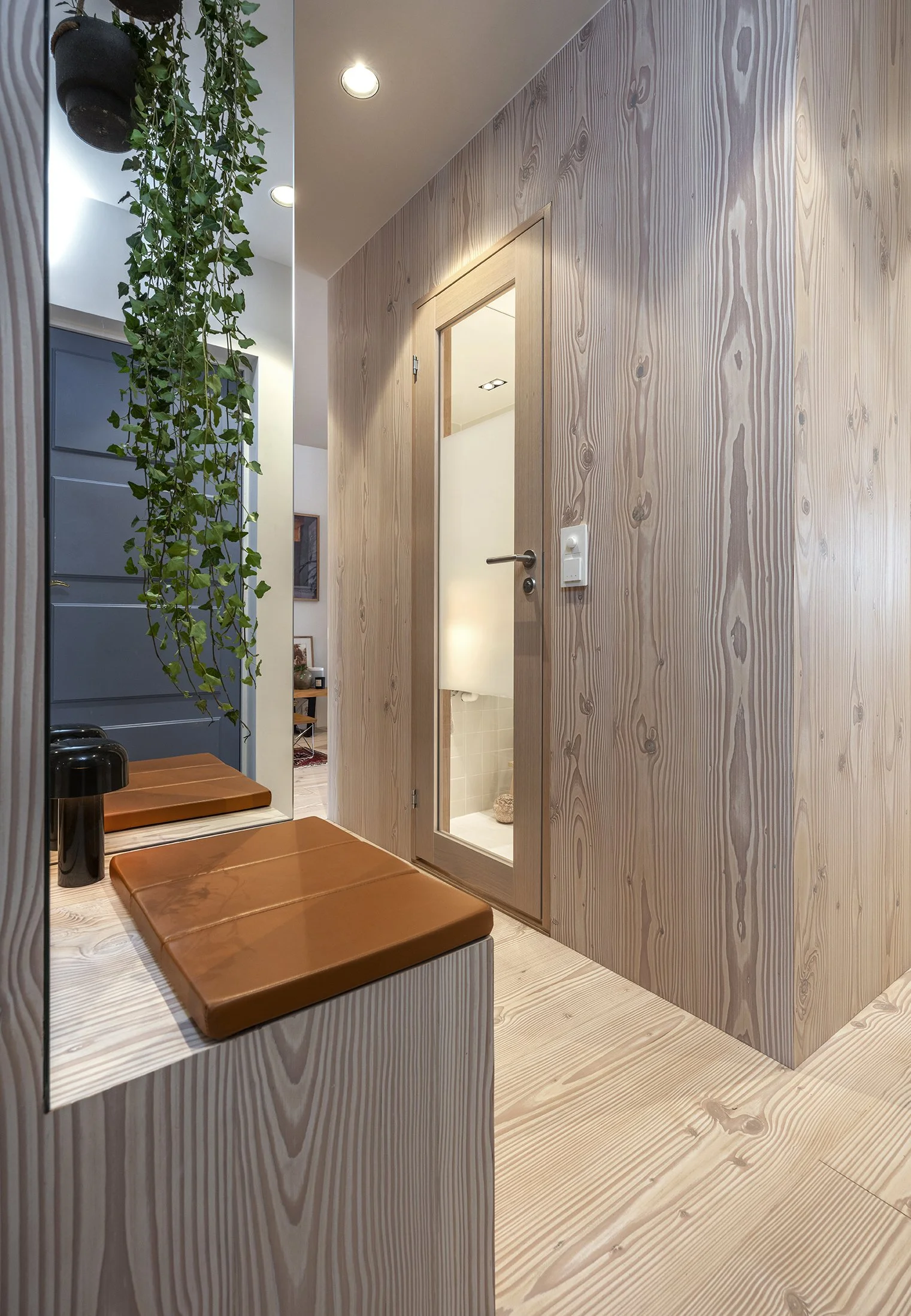
Welcome. One corner of one of the boxes forms the entrance hall, with a Kobro seat cushion from Pure Norsk, designed by Anderssen & Voll, and a rechargeable lamp from Flos. The bathroom with bathtub is behind the glass door in box number two.

The red room. The guest bathroom has been fitted with a mini bathtub from Hafa and a small sink from Pulcher. This bathroom has been fitted with bright red Vola fittings. Plant stools on the floor from Kollekted By.
design savvy
By inserting the fireplace inserts into the tiled surfaces of the boxes, he has created a modern interpretation of old tiled stoves. The chef points to the handle of the fireplace inserts, which bears a striking resemblance to the handle of a Global kitchen knife. In the space between the dining table and the small lounge, there is a kitchen centrepiece from Ikea where a Queen Elisabeth doll is accompanied by an ‘I'm alive’ sign. The lamps in the apartment are various classics designed by everyone from Achille Castiglioni to Paolo Rizzatto. The strong contrasting colours of the various lamp parts are accompanied by colourful small design objects that collectively contrast the otherwise white surfaces.
- ‘I didn't want to paint the walls, but rather let the colours of individual objects stand out. I have to admit that I'm crazy about lamps. I've even lent designer lamps to friends of mine,’ he laughs, adding that all the objects have a special sentimental value.


Open and closed. A glass sliding door between the living room and bedroom allows light to pass through. The bedroom curtain can be pulled further in front of the glass door via a rail in the ceiling to block the view through the glass door.

Practical and delicate. The Kubo sink in Corian is from Pulscher with an Ikea shelf on wheels. Bright blue Vola fittings, designed by Arne Jacobsen in 1968, have been chosen for the main bathroom. A light blue dish from Hay is filled with hand soap and creams. Here, the spotlights are recessed into the ceiling. They also send light out through the window recess.
planned solution
Older artefacts such as an old pig trough, a wooden nesting box and my great-grandmother's old kitchen shelf all bear witness to the chef's upbringing on Veiby farm. The wall light above the kitchen sink is from the pigsty and two cacti in the small window sill in the laundry room are over 50 years old and an heirloom from his grandmother. All around the room, one classic piece of furniture after another is very carefully placed.
- ‘I'm not a redecorator. The whole apartment is designed down to the last detail. That's how I wanted it,’ concludes the architect and chef with a satisfied smile.

